
The intense cold wave snuffed out 15 more lives in Uttar Pradesh taking the toll to 155 as mercury continued to plunge with Muzaffarnagar recording a low of 0.2 degree Celsius.
The minimum visibility in the Palam area, where the airport is located, fell to near zero levels, a Met official said.
.jpg)
An El Nino is a temporary change in the climate of the Pacific Ocean, in the region around the equator.
The rain gauges at the Safdurjung MeT station measured 9.5 mm of showers for a period of 24 hours till 8:30 am while Palam station recorded 56.8 mm during the same period.
Delhiites woke up to the coldest Christmas in five years on Sunday as the mercury plunged to the season's lowest of 2.9 degrees Celsius, five degrees below normal.

Large swathes of the country reeled under heatwave conditions on Tuesday with Churu in Rajasthan recording a high of 48 degree Celsius.


Delhiites woke up to a chilly morning with the mercury dipping to 6.8 degree Celsius, a drop of nearly five notches from Saturday when the minimum settled at 11.5 degree.
Most parts of the north India on Tuesday experienced a chilly day as mercury dropped further by a few notches amid foggy conditions, with the national capital recording its lowest temperature this season.

The two neighbouring states have been reeling under a cold wave with night temperatures ranging upto 2 degrees Celsius below normal at some places.
Office-goers had a tough time following traffic jams due to water logging.

Traffic in national capital Delhi and adjoining Gurugram went haywire on Wednesday after heavy rains resulted in waterlogging in many parts of the city.

Officials in the weather department said the monsoon is expected to be below normal because of the El-Nino effect.

Delhi on Tuesday recorded the coldest day of the year so far at 4 degree Celsius, four notches below normal, even as dense fog led to cancellation of 13 trains.

Light to moderate rainfall in various parts of the country, including Delhi, on Tuesday brought respite from the scorching sun but heat wave claimed 16 more lives in Andhra Pradesh and three in Odisha, raising the nationwide toll to 2,357.
No disturbance in air traffic has been reported due to weather conditions.
Pathankot, Bathinda, Amritsar, Ambala and Sonipat, continued to witness foggy conditions in the morning.
Dense fog engulfed the region again reducing visibility considerably, which threw train schedules haywire and created traffic snarl-ups on highways.

A dense blanket of fog enveloped the entire North India affecting schedule of at least 70 trains and hitting road traffic adversely while there was no let up in cold wave on Saturday which claimed five lives in Uttar Pradesh and two in Punjab.
Fog envelops Delhi; flight operations uninterrupted
Dense fog and cold weather conditions continue in the national capital as the mercury plunges to 2.6 degree Celsius, five notches below normal on Monday.
The cold wave sweeping most parts of north India intensified and Ambala recorded a low of 3.6° C, down three degrees, while Karnal was also colder by three degrees at 4.1° C.

In Uttar Pradesh, southwest monsoon has been normal so far where rains and thundershowers occurred in few places since Friday.
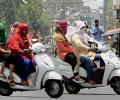
Two persons were killed in Uttar Pradesh's Ballia district as strong winds and thunder showers hit several parts of the state. While one died in a tree fall incident the other was hit by lightning, the police said.

A below-normal monsoon can bring down India's GDP growth by 0.50-0.75 per cent this financial year, forcing the Reserve Bank to delay rate cuts to 2015, Bank of America-Merrill Lynch (BofA-ML) said.
Heavy rains lashed the national capital, bringing much needed respite from hot and humid conditions, but also caused water-logging and brought the traffic to a standstill in various parts of the city on Tuesday evening.

'We are not saying we are going to face a drought... We are a doing and performing government. A contingency plan is being prepared,' Science Minister Dr Harsh Vardhan tells Rediff.com

The 126.6 mm rainfall that the city received in the 12-hour period from 8.30 am to 8.30 pm on Monday exceeded the 114.5 mm it got on July 30, 2016, and July 21, 2015's meagre record of 61 mm.

The national capital has received the season's highest rainfall at 63.1 mm.

Weather watchers said it can't be known till May whether El Nio will impact the monsoon or not.
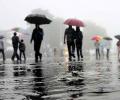
India will receive normal monsoon this season, country's meteorological department said on Wednesday in its forecast for the Southwest monsoon that covers 75 per cent of the country, and thereby may bring much-needed respite to the economy, which is reeling under the catastrophic effect of the Covid-19 pandemic.

At least 33 people have been killed in flash floods in Bihar till Tuesday evening and 25.71 lakh people are affected in 16 districts of the state.

Intense cold conditions continued unabated in the northern region disrupting transport services on Wednesday as mercury dropped by several notches and fog enveloped most parts, causing poor visibility and resulting in death of 10 people in road accidents.

A deadly snowstorm has resulted in cancelled flights, and stranded motorists, and has prompted a state of emergency in western New York, and left at least five people dead in the north-eastern United States.

North India was in the grip of intense cold with 40 days of harshest winter period 'Chillai-Kalan' beginning in Jammu and Kashmir on Saturday and icy winds sweeping across the plains.

Several flights and trains were delayed on Tuesday as the entire North India reeled under a dense blanket of fog.

Light to heavy rains lashed several parts of north India intensifying cold wave conditions in the region following snowfall in higher reaches that brought down day temperature considerably in Delhi and neighbourhood.

Intense cold conditions prevailed in parts of north India on Sunday as the mercury plummeted to minus 12.6 degrees Celsius in Leh, while the Kashmir valley braced for possible snowfall over two days from Monday

IMD will present its month-wise and region-wise forecast in June.

Delhi's air quality was again in the severe category with the 24-hour average AQI recorded at 403 after remaining in the 'very poor' category till Tuesday morning, when the AQI was recorded at 396.
